
Palletizing Robot Cost Breakdown: What a Robot Palletizing Cell Really Pays Back
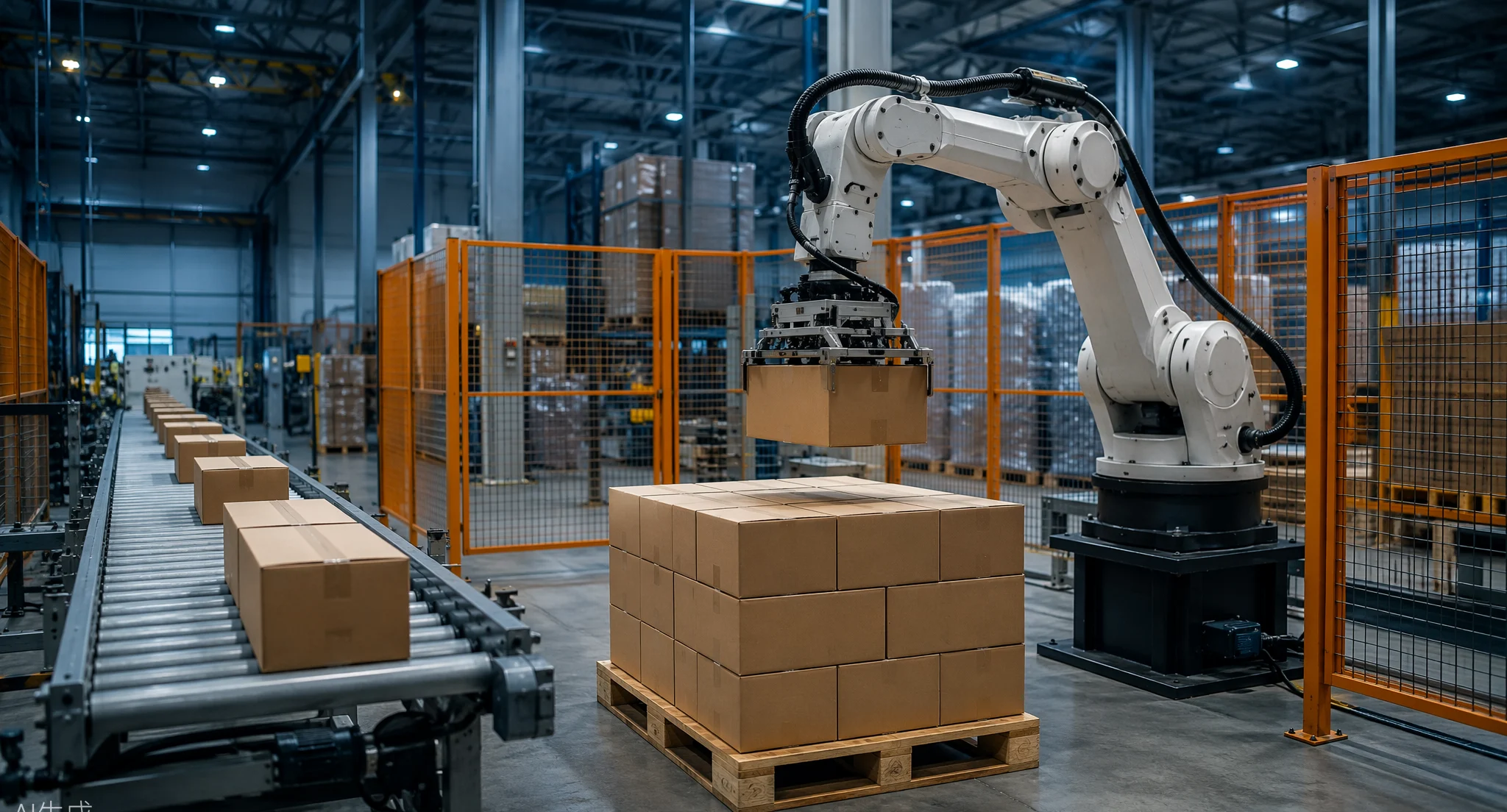
Labor is the reason most factories start looking at a palletizing robot. Bags and cartons keep arriving at the end of the line, crews are hard to hire and harder to keep, and every lift above shoulder height carries an injury risk. The questions that follow are always the same: what does a robot palletizing cell cost, and how fast does it pay back? The honest answer is "it depends", but the structure of the answer is stable, and this breakdown covers the factors that decide the return.
Manual palletizing versus a palletizing robot
| Factor | Manual palletizing | Robot palletizing cell |
|---|---|---|
| Labor per line | One to two workers per shift | One operator can supervise one or more cells |
| Cycle consistency | Slows as fatigue builds across a shift | Stable cycle time, shift after shift |
| Injury exposure | Repetitive lifting of 20–50 kg units | Fenced cell removes routine lifting from workers |
| Staffing risk | Heavy repetitive work is difficult to staff in many regions | Depends on technician availability rather than manual crews |
| Multi-shift operation | Requires duplicated crews | The same cell runs two or three shifts |
None of this means manual palletizing is always wrong. Very low volumes, highly variable pack formats, or short seasonal campaigns can keep a manual station rational. Automation earns its place when utilization is high enough that the cell spends most of its time stacking rather than waiting.
What a palletizing robot cell costs
The total project price depends on layout, product mix and options, but the cost structure of a palletizing cell is consistent from project to project:
| Cost component | What it covers | Notes for budgeting |
|---|---|---|
| Robot body | The articulated arm, controller and teach pendant | Payload and reach decide the model; four-axis palletizing robots commonly cover roughly 50–800 kg payloads, while six-axis robots handle the lighter 8–200 kg range. |
| Gripper (end-of-arm tooling) | Clamp, fork or vacuum tooling matched to cartons, bags or bundles | Product mix decides complexity; quick-change grippers cost more but reduce changeover time. |
| Conveyors and pallet handling | Infeed conveyors, pallet dispensers and slip-sheet options | Often the most layout-dependent part of the budget. |
| Safety system | Fencing, light curtains, interlocked gates and stack lights | Required for compliance in most export markets. |
| Integration and commissioning | Programming, pattern recipes, installation and operator training | Depends on SKU count, pallet patterns and site condition. |
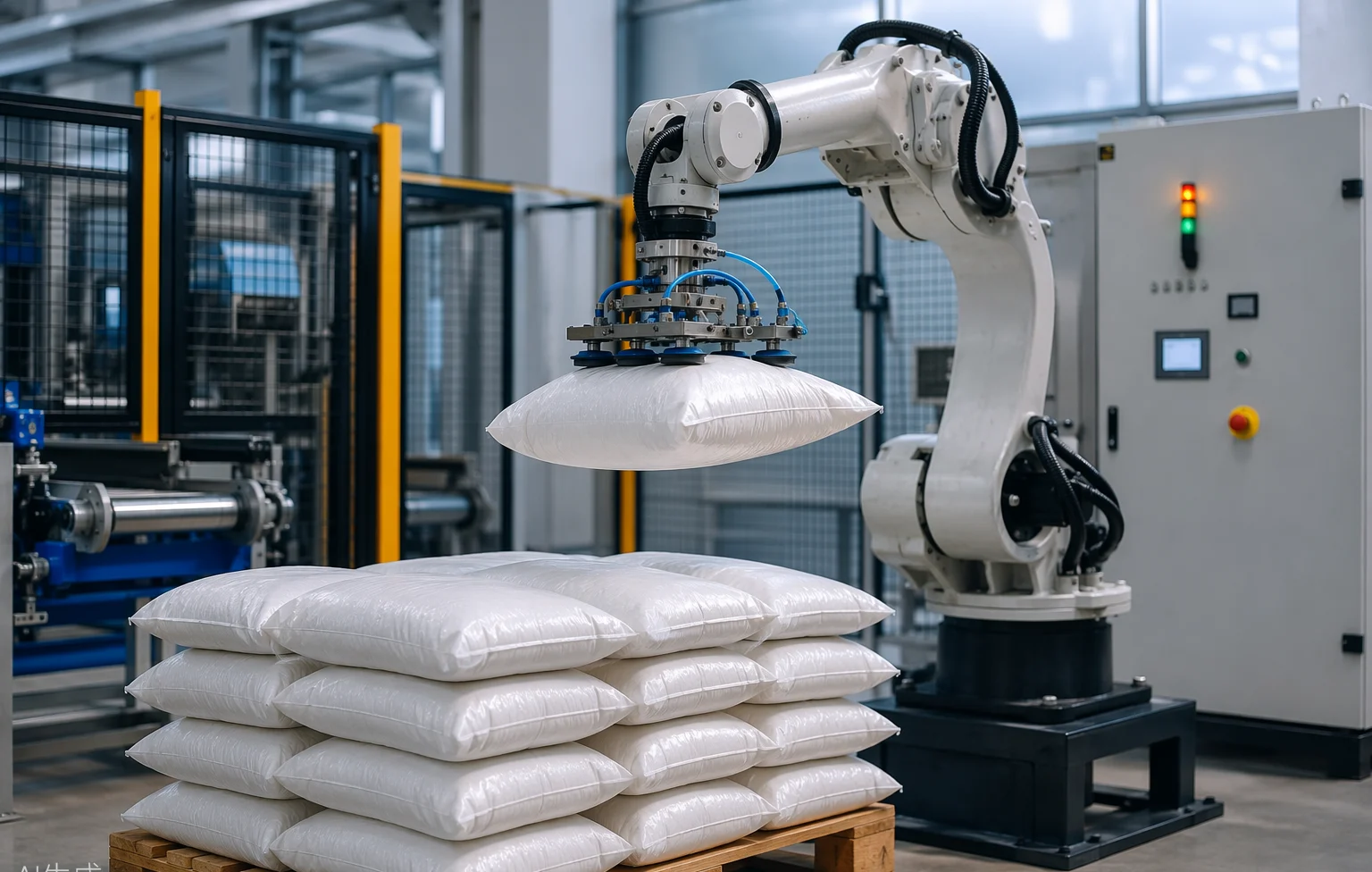
What drives the payback period
The ROI of a robot palletizing cell depends on a small set of drivers rather than on the robot brand alone:
- Shifts per day. A cell that replaces one worker on one shift pays back slowly; the same cell running two or three shifts replaces several full-time positions and usually pays back far faster.
- Local labor cost and availability. Higher wages, and regions where heavy lifting jobs go unfilled, both shorten the payback period.
- Product mix and changeover. Stable pallet patterns keep utilization high; frequent format changes need recipe-based programming and suitable grippers.
- Upstream reliability. The cell only earns money when the line ahead of it runs, so infeed condition belongs in every ROI discussion.
Across the industry, well-utilized multi-shift cells commonly recover their investment in roughly one to two years, while single-shift projects depend more on labor scarcity and avoided injury costs. Exact figures always depend on wages, shift pattern and utilization, so any quotation should state these assumptions openly.
A reliable quotation should itemize these components separately rather than quoting one lump sum. Itemization lets buyers compare robot models on payload and reach, judge whether the gripper and conveyor scope matches the product mix, and see clearly which options add payback-relevant capability and which are simply nice to have.
A simple payback sanity check
Buyers can test any proposal with one line of arithmetic: installed cell cost divided by the annual cost it removes. The removed cost is mainly the wages, insurance and turnover cost of the palletizing positions the cell replaces across all shifts, plus avoided injury and downtime losses where records exist. A cell that replaces two positions on each of two shifts removes a cost base roughly four times one annual position cost; the same cell on a single shift removes half of that. If the resulting figure lands far beyond two years, the utilization plan usually deserves another look before the budget does.
Service terms belong in the same calculation. Remote diagnostics, spare-part lead time and operator training decide how quickly a stopped cell earns again, and they differ far more between suppliers than the robot hardware itself.
What to prepare before requesting a quotation
Suppliers can size and price a cell much faster when the project data is complete:
- Carton or bag dimensions, unit weight and surface condition
- Required line speed in units per hour
- Pallet size, target layer pattern and stack height
- Available floor space and the infeed conveyor height
- Shift pattern, SKU count and local electrical standard
Where ZOYVAN fits in a palletizing project
ZOYVAN builds the MD series four-axis palletizing robot for 50–800 kg payloads and the CR series six-axis robot for 8–200 kg handling and machine tending, together with the grippers, conveyors and safety systems that complete a cell. Pallet pattern recipes, dual-pallet changeover and stretch-film or slip-sheet options are configured to the product mix rather than sold as fixed packages. The industrial robot palletizing and handling solution page shows typical cell layouts, and the buyer FAQ answers common questions about robot ROI, after-sales support and export certification. Share your carton or bag size, unit weight, line speed and shift pattern, and a cell configuration with a realistic payback estimate can be prepared for project review.