
What is the typical ROI payback period of your industrial robots, and how much productivity can be improved?
Based on 2026 global manufacturing data from our current customers' application, our industrial robotic arms deliver clear quantifiable efficiency upgrades for welding, palletizing, handling, assembly and machining processes. ROI from 6 month to 12month.
What after-sales service and global technical support can your robot factory provide for overseas customers?
- Remote real-time troubleshooting All robots support remote online diagnosis, program modification and fault elimination via network, which solves 80% of daily operation problems without local engineers on-site.
- Training & Operation Guidance We supply free English-language operation manuals, programming video tutorials, and one-on-one online training for your maintenance and operation teams; offline on-site commissioning and training can be arranged for large turnkey projects.
- Fast spare parts supply Core wearing parts and vulnerable components are in stock in our warehouse, with delivery to most countries within 7–15 working days; we also provide long-term preferential spare parts supply contracts for long-term partners.
- Warranty Policy Standard 12-month warranty for robot main body, lifetime paid technical consultation and software upgrade service.
Are your industrial robots certified for global export? Can they be integrated with our existing factory automation systems?
- Full International Certifications for Global Shipment Our robotic products pass CE, ISO9001 certifications, and can apply for Russia, Southeast Asia, the Middle East and European markets separately, which smoothly clears customs clearance in 40+ countries and regions. The protection grade reaches IP65, adapting to dusty, splash and harsh workshop environments such as metal processing and welding workshops.
- Powerful System Compatibility & Integration Our controllers support seamless docking with mainstream brands of PLC, MES, HMI and production management systems including Siemens, Mitsubishi, Omron and Modbus protocol. We reserve standard communication interfaces for automatic production line linkage, offline programming simulation and data upload for production big data statistics.
- Customized Turnkey Solution Our factory can design non-standard fixtures, vision positioning systems and full automation robotic workstations according to your on-site production process, realizing plug-and-play delivery for overseas factories.
What information should I provide for an aluminum extrusion quotation?
A complete request helps the engineering and commercial teams review the project efficiently. Include:
- a profile drawing or 3D file, preferably DWG, DXF, STEP, or a dimensioned PDF;
- the requested alloy and temper, or the performance requirements when these are not yet fixed;
- critical dimensions, tolerances, cut lengths, and expected quantities;
- surface finish, color, visible-surface requirements, and any secondary machining;
- inspection, certification, labeling, packaging, and delivery requirements.
When some details are still open, describe the application and operating environment so suitable options can be reviewed with you.
Which aluminum alloys and tempers are commonly used for extrusion?
Six-thousand-series alloys are widely used for extruded profiles because they offer a practical balance of extrudability, strength, corrosion resistance, machining, and finishing performance.
The correct alloy and temper depend on structural load, geometry, forming needs, welding, anodizing appearance, corrosion exposure, and regulatory requirements. Final selection should be confirmed against the project drawing and intended application rather than chosen from a generic list alone.
Can ZOYVAN support custom aluminum profiles?
Yes. Custom-profile review normally begins with the section drawing, alloy, temper, dimensional requirements, finish, cut length, and expected volume.
The team can then assess extrusion feasibility, identify features that may benefit from design adjustment, and define the tooling, sample approval, inspection, and production path. Tooling and production commitments are confirmed only after the technical review.
Which surface finishes can be specified for aluminum profiles?
Typical project options can include mill finish, anodizing, powder coating, brushing, polishing, and other decorative or protective treatments.
Finish availability and appearance depend on alloy, profile geometry, visible-surface definition, color target, gloss, texture, corrosion exposure, and order volume. Reference samples and measurable acceptance criteria should be agreed before production when appearance is critical.
How are dimensional tolerances and inspection requirements handled?
Dimensions and tolerances are reviewed from the approved drawing. Critical characteristics should be identified clearly so the inspection method, sampling plan, gauges, records, and any material or finish certificates can be agreed before production.
Very tight tolerances may affect profile design, tooling, straightening, machining, inspection cost, and achievable yield. They should therefore be applied where the function requires them instead of uniformly across every dimension.
Can extruded profiles receive machining or fabrication after extrusion?
Depending on the project, post-extrusion work can include precision cutting, drilling, milling, tapping, punching, deburring, surface preparation, and assembly-related operations.
Send the finished-part drawing rather than only the raw extrusion section. This allows datum strategy, machining access, tolerance stack-up, finish protection, inspection, and packaging to be reviewed as one manufacturing route.
What factors affect minimum order quantity and lead time?
MOQ and lead time are project-specific. Important factors include new tooling, alloy and billet availability, profile complexity and weight, sample approval, finish and color, secondary processing, inspection documentation, packaging, and production scheduling.
Provide the prototype quantity, expected production quantity, annual demand, and target delivery date. A confirmed schedule can then be issued after the drawing and process route have been reviewed.
How can recycled aluminum support a more circular manufacturing route?
Recycled aluminum can reduce reliance on primary material, but the appropriate recycled-content target depends on alloy chemistry, mechanical and appearance requirements, traceability, certification, and available supply.
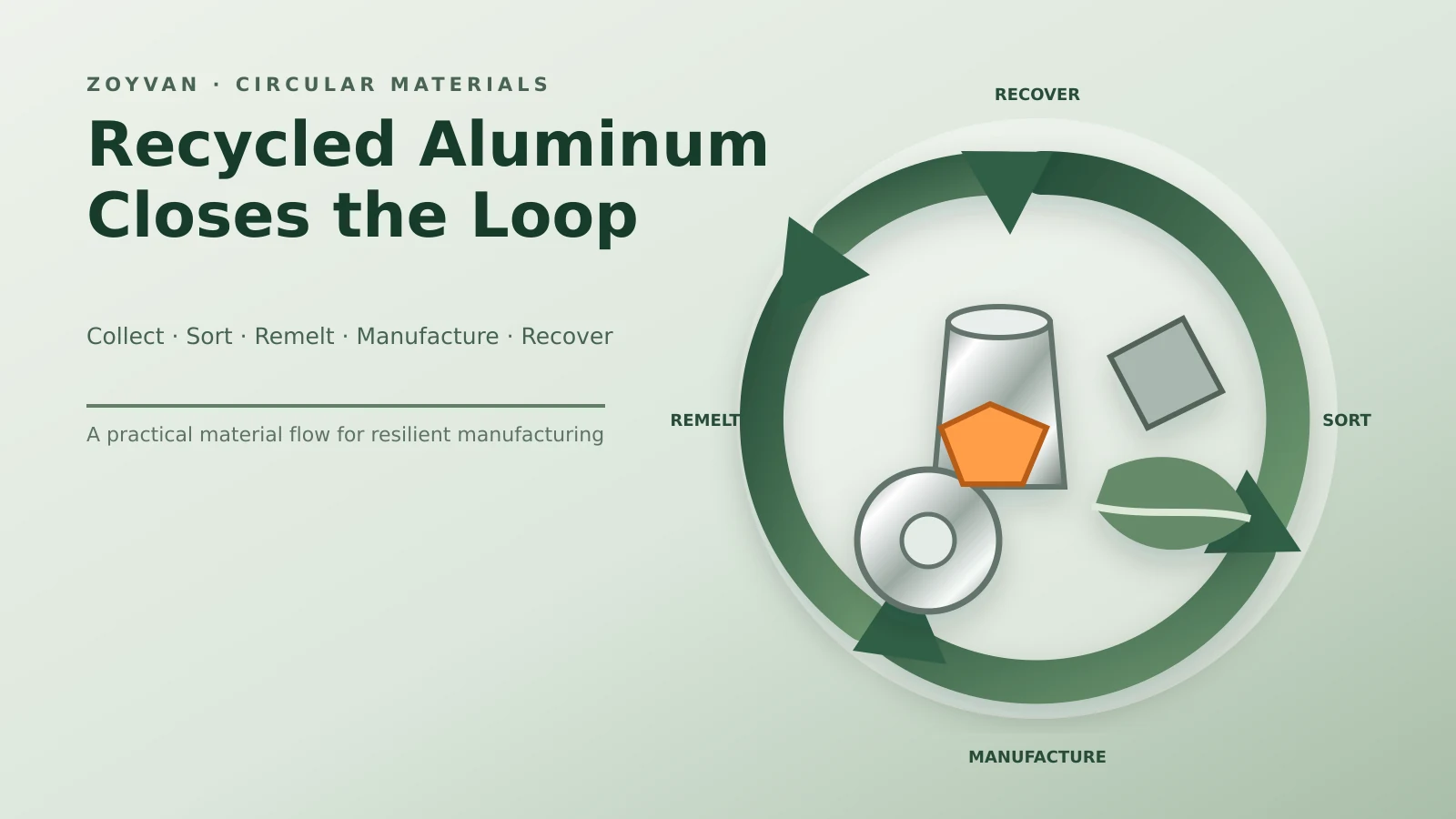
Define recycled-content and documentation expectations early so the material route can be reviewed together with extrusion, finishing, quality, and end-of-life recovery requirements.
How should aluminum profiles be packed for international shipment?
Packaging should match the finish sensitivity, profile length and shape, handling method, transport route, storage conditions, and customer unloading process.
Options can include protective film, interleaving, sleeves, bundled wrapping, cartons, reinforced crates, moisture protection, and project-specific labels. Visible or finished surfaces should be identified on the drawing or packaging specification so contact points and protection can be planned correctly.
Should I choose a six-axis industrial robot or a four-axis palletizing robot for my application?
The choice depends on the motion your process requires. CR series six-axis industrial robots (8-200 kg payload) move the tool freely through almost any position and orientation, so they suit machine loading and unloading, welding, spraying, and handling tasks where the workpiece must be presented at changing angles. MD series four-axis palletizing robots (50-800 kg payload) are built for fast, repetitive vertical stacking of bags, cartons, frames, and drums, where reach and cycle rate matter more than wrist flexibility.
If you are not sure, send us your workpiece drawing, weight, and target cycle time. Our engineers will recommend the most economical configuration for your layout.
How do I match robot payload, reach, and cycle time to my workpiece and production capacity?
Start from three numbers: the gross load (workpiece plus gripper weight, with a safety margin), the working radius between the farthest pick and place points, and the takt time your line must achieve. Payload should never be sized from the workpiece alone - the end effector, cables, and acceleration forces all consume part of the rated capacity.
Share your workpiece weight and dimensions, a simple layout sketch with pick and place positions, and your target output per shift. Our team will run a reach and cycle-time check and confirm which CR or MD series robot model fits before quotation.
Can you customize end-of-arm tooling and grippers for our workpieces?
Yes. ZOYVAN's in-house mechanical and electrical team designs and builds custom end-of-arm tooling, including mechanical clamps, vacuum grippers, magnetic grippers, and dedicated bag or drum grippers matched to your workpiece shape, weight, and surface condition.
The gripper is engineered together with the robot, conveyors, and an optional vision system as one workstation, then assembled and test-run in our Zhongshan factory before shipment. To start an evaluation, send the workpiece drawing, photos, or a short video of your current handling process.
Can your industrial robots be adapted to the voltage and electrical standards in our country?
Yes. Robot control cabinets and workstation electrics can be configured for the grid conditions of the destination country, covering common industrial supplies such as 220 V, 380 V, 400 V, and 440 V at 50 or 60 Hz, with an isolation transformer fitted where required. Cable specifications, cabinet protection, and connectors are arranged according to local installation practice.
Please confirm your local voltage, phase, and frequency when sending an inquiry. The final electrical configuration will be stated clearly in the quotation and marked on the machine nameplate.
What is the typical delivery lead time for an industrial robot order?
Lead time depends on the model, order quantity, and the level of customization. Standard robot bodies from the CR and MD series are usually faster to deliver, while complete robotic workstations with custom grippers, conveyors, or vision systems need additional time for engineering, assembly, and pre-shipment testing.
Because every project is different, we do not publish a generic figure: the confirmed production and delivery schedule is stated in the quotation and contract for each order. Export packing and sea or air freight arrangements are coordinated with your forwarder or ours.
How is installation and commissioning arranged for overseas robot projects?
We offer three routes depending on project size. Standard single-robot cells can be installed by your own team with our remote guidance, using English manuals, wiring diagrams, and live video support. Complete robotic workstations can be commissioned by ZOYVAN engineers dispatched to your site, or by your local distributor's engineers with our backing.
To shorten on-site work, every workstation is pre-assembled and test-run in our Zhongshan factory before shipment. On-site schedule, visa, and travel arrangements are confirmed case by case during contract discussion.
How do you provide operation and maintenance training for our team?
Every robot ships with English operation manuals and programming video tutorials, and we arrange one-on-one online training sessions covering teach pendant operation, program editing, safety practices, alarm handling, and routine maintenance. For turnkey workstation projects, on-site training is carried out together with commissioning.
Distributor engineers can also attend structured training at our Zhongshan factory, so your local partner can support daily operation and first-level maintenance in your own language and time zone.
Which spare parts should we keep in stock, and how are replacements supplied?
Each industrial robot is delivered with a recommended spare parts list covering typical wearing and consumable items such as encoder batteries, grease, belts, fuses, and contactors, with part numbers listed in the manual. For production-critical lines we suggest keeping one set of the recommended items on site.
Common parts are stocked at our Zhongshan warehouse and shipped internationally by express; delivery time depends on destination and customs clearance. Distributors normally hold regional stock, and long-term spare parts supply agreements are available for fleet customers.
What routine maintenance does an industrial robot need, and how often?
Daily care is simple: keep the robot and its workspace clean, watch for abnormal noise or alarms, and confirm that cables and hoses are not rubbing. Weekly or monthly checks cover connectors, mounting bolts, and the condition of the dress-out cables.
Longer-interval items, such as reducer grease replacement, encoder battery replacement, and brake checks, are based on running hours and are listed model by model in the maintenance manual. Our remote diagnosis function helps monitor robot condition, and our support team can remind you when key service points are due.
What cooperation policy do you offer for overseas distributors and agents?
For distribution partners, ZOYVAN provides regional market protection for registered projects, distributor-level pricing with room for a healthy margin, and support for demonstration machines and local exhibitions. We also supply marketing materials, sales leads from your region, factory training for your engineers, and priority technical support.
For end users this means a local contact, faster response, and the same factory backing behind every industrial robot. Territory scope, annual targets, and the detailed support package are discussed market by market and fixed in the distribution agreement.